FDA PCAC reviews 7 peptides in July. Read →

PeptideXpo

Manufacturing Facility

One Shanghai facility. Single quality system.

Synthesis, purification, lyophilization, sterile vial fill, analytical release testing, and cold-chain dispatch, all under one roof and one quality-management framework. No outsourced production steps. Every batch is traceable to a single document-control system from incoming raw material through outbound shipment.

See the line

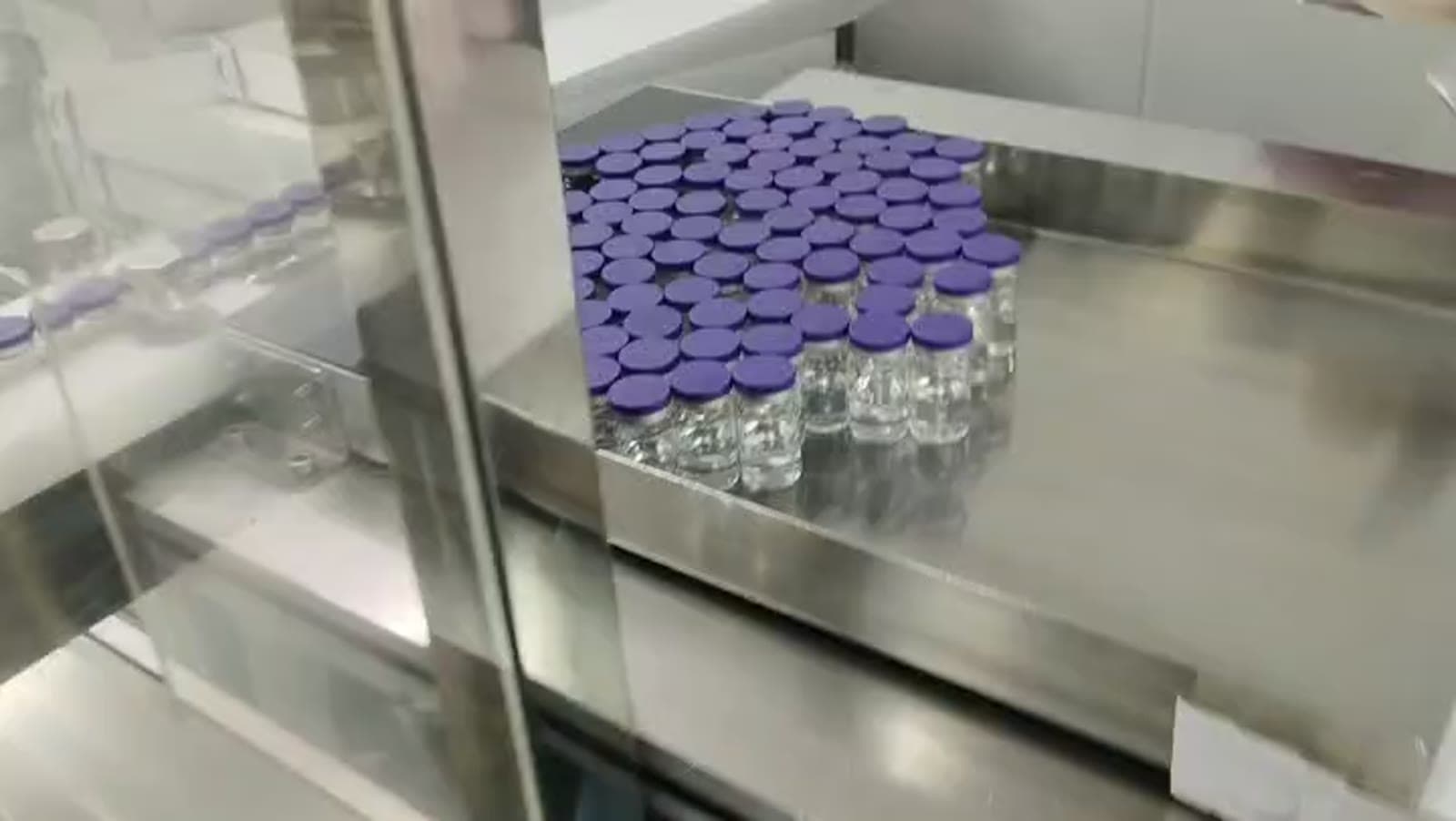
A 30-second walk-through of the vial-filling line.

The video below was captured on-site during an actual production day. Same line every order ships from. No stock footage, no staged-photography compositing.

ISO 7/8 vial-filling line · 30s walk-through

Captured on-site during a production day in Shanghai.

Production process

Nine stages from raw material to released batch.

Each stage has documented in-process controls and a downstream-quality gate. Failed controls trigger investigation and rework before the batch advances; nothing skips forward on assumption.

01

Raw material qualification

Every incoming Fmoc-protected amino acid, coupling reagent, and process solvent is qualified against pharmacopeia specifications before release to the synthesis floor. Per-lot identity, purity, and water content are confirmed at receipt; out-of-spec material is quarantined and returned to the supplier with non-conformance documentation.

02

Solid-phase synthesis (SPPS)

Fmoc-strategy SPPS on multiple parallel reactor lines, scale-graded from research-batch (10-100 g) through pilot (1-10 kg) to commercial production. Synthesis cycle yield is monitored at every coupling-deprotection iteration; failed-coupling cycles trigger re-coupling before the next residue addition.

03

Crude cleavage & precipitation

TFA-based cleavage from the resin under controlled-temperature conditions appropriate to the side-chain protection scheme. Crude peptide is precipitated into cold ether, washed, and held under nitrogen prior to purification. The crude-cleavage step is a critical-quality checkpoint for peptides with oxidation-sensitive residues.

04

Reverse-phase HPLC purification

Preparative RP-HPLC at column scales from analytical (4.6 mm internal diameter) through semi-preparative (50 mm) to production (300+ mm). Purification cycles target ≥99.0% area-purity on the analytical re-injection. Closely-eluting truncation and deletion impurities are cut against measured chromatographic resolution rather than blind retention-window assumption.

05

Counter-ion exchange

TFA-salt material from purification is exchanged to the target counter-ion (acetate by default) by either repeated lyophilization from dilute acetate buffer or ion-exchange chromatography. Counter-ion content is quantified on the released batch, acetate-salt material typically reports 4-12% counter-ion by mass.

06

Lyophilization

Freeze-drying under vacuum with controlled shelf-temperature ramp and ice-condenser tracking. Lyophilization cycle parameters are optimized per peptide class, short hydrophilic peptides versus longer lipidated peptides versus copper-coordinated peptides each have different optimal cycles. Residual moisture is measured post-lyophilization by Karl Fischer.

07

ISO 7/8 sterile vial fill

Sterile-filtration through 0.22 µm filters into sterile holding tank, followed by aliquot fill into pre-sterilized vials under ISO 7/8 cleanroom conditions. Vial-fill weight is verified gravimetrically per-vial during the session; container-closure integrity (CCI) is tested on a sampling basis per the release protocol.

08

Analytical release testing

Released-batch QC covers HPLC purity (target ≥99.0% area), ESI mass spec confirming molecular weight within 0.5 Da of theoretical, water content by Karl Fischer, counter-ion content, and (for >15-residue peptides) LC-MS/MS sequence verification. Add-on tests on request: LAL endotoxin per USP <85>, microbial limits per USP <61>/<62>, stability data on the specific lot.

09

Cold-chain shipment

Outbound shipment uses validated insulated packaging with continuous temperature monitoring throughout transit. Frozen-route shipments use dry-ice with 72-120 hours hold time; refrigerated-route shipments use PCM gel-pack with 48-72 hours hold. Every shipment carries an electronic temperature data logger that becomes part of the released-batch documentation chain at receipt.

Capabilities at a glance

What the facility can produce and what we measure on every release.

Synthesis scale

  • Research-batch: 10-100 g per synthesis cycle
  • Pilot-commercial: 1-10 kg per cycle
  • Commercial: 10+ kg per cycle, with multi-cycle aggregation for larger orders
  • Custom modifications: Aib, Dmt, D-amino acids, fatty-acid lipidation, PEG conjugation, intramolecular disulfide bridging, N/C-terminal capping

Analytical capabilities (on-site)

  • RP-HPLC with PDA and ELS detection
  • ESI mass spectrometry (LTQ Orbitrap)
  • LC-MS/MS sequence verification
  • Karl Fischer titration (water content)
  • Gas chromatography (residual solvents)
  • Atomic absorption / ICP-MS (trace metals, copper content)

Add-on testing (on-site or accredited third-party)

  • Bacterial endotoxin (LAL) per USP <85>
  • Microbial limits per USP <61>/<62>
  • Bioburden screening
  • Stability data (accelerated 40°C/75% RH + real-time 25°C/60% RH)
  • Bioactivity confirmation (cell-proliferation or receptor-binding assay, where appropriate)

Fill formats

  • Lyophilized bulk powder (kg-scale)
  • Lyophilized vials (2 mg through 120 mg fill ranges)
  • Sterile-filled vials under ISO 7/8 (with USP <71> sterility + CCI)
  • Pre-mixed aqueous solutions (B-12, L-Carnitine, lipotropic blends)
  • Custom OEM fill formats (private-label vials, ampoules, cartridges)

Audit & inspection

Open to qualified buyers under NDA.

Established commercial buyers, 503B outsourcing facilities, pharmaceutical CDMO partners, large compounding-pharmacy networks, and downstream finished-product brand owners, can request on-site facility audits as part of supplier qualification. Typical audit scope covers production-line walkthrough, QC laboratory access, document-system inspection, raw-material qualification review, and sample-retention room access.

Audit scheduling typically runs 4-6 weeks lead time because we coordinate the audit team's access against ongoing production schedules. Mutual NDA is signed before document-system access; specific commercial-information protection scope is negotiated per audit. Travel coordination, on-site logistics, and post-audit documentation are handled by our quality team.

Frequently asked

Common questions about the facility.

Where is the PeptideXpo manufacturing facility located?

Our manufacturing site is in the Shanghai metropolitan area, the city that hosts the largest concentration of pharmaceutical-API contract manufacturers in Asia and where most of the specialised peptide-synthesis talent and infrastructure are co-located. All product shipments originate from this single facility under a single quality system rather than being aggregated from multiple third-party suppliers.

What does "single quality system" actually mean operationally?

Every step from incoming raw-material qualification through synthesis, purification, lyophilization, sterile vial fill, secondary packaging, batch release, and outbound cold-chain logistics is performed under one quality-management framework with one document-control system and one batch-traceability chain. No production step is outsourced to a third party. The practical consequence: if you receive a batch with an analytical anomaly, the audit trail back to the synthesis cycle, the operator, the raw-material lot, and the QC method is all in one document set, not stitched across multiple suppliers' systems.

What cleanroom classification does the vial-filling line operate under?

Sterile vial-filling operations run under ISO 7/8 cleanroom conditions per ISO 14644-1, the standard cleanroom specification for aseptic pharmaceutical fill-finish operations in non-EU/US-FDA-regulated facilities. Particulate-count monitoring runs continuously during fill sessions; non-viable particles are tracked at the 0.5 µm and 5 µm thresholds, and viable particle counts are sampled per filling-session at fill-line, operator, and ambient positions. Cleanroom HEPA filters are integrity-tested per the standard schedule.

Do you offer facility audits for qualified buyers?

Yes. Established commercial buyers with appropriate confidentiality framework (mutual NDA) can request on-site facility audits, typical scope covers production-line walkthrough, QC laboratory access, document-system inspection, raw-material qualification review, and sample retention room access. Audit scheduling typically runs 4-6 weeks lead time because we coordinate the audit team's access against ongoing production schedules. 503B-pathway buyers and pharmaceutical CDMO partners are the most common audit requesters.

What analytical equipment is on-site versus outsourced?

On-site analytical equipment covers the standard release-testing scope: reverse-phase HPLC (multiple instruments, with photodiode-array and ELS detectors for the broader compound classes), ESI mass spectrometry (LTQ Orbitrap for high-resolution identity confirmation and tandem-MS sequence verification), Karl Fischer titration for water content, gas chromatography for residual-solvent screening, and atomic absorption / ICP-MS for trace-metal and copper-content verification on the copper-peptide product line. Outsourced testing: USP <85> bacterial endotoxin (LAL) and USP <61>/<62> microbial limits run at an accredited third-party laboratory for added independence, with results consolidated into the batch COA before release.

How are batches stored and shipped to preserve cold-chain integrity?

Released-batch material is held at -20 °C in dedicated cold storage with continuous temperature monitoring and door-event logging. Outbound shipments use validated insulated packaging with the appropriate cold-chain configuration for the destination market: dry-ice for frozen-route shipments (typically 72-120 hours hold time), gel-pack with PCM (phase-change material) for refrigerated 2-8 °C routes (typically 48-72 hours), and ambient-tolerant packaging for lyophilized material where the destination regulatory framework permits ambient-shipping. Every shipment carries an electronic temperature data logger; the temperature record becomes part of the released-batch documentation chain.

Let's talk peptides.

First response under 12 hours · Catalog · Sample COA · MOQ · Lead time. Our regulatory and sales teams review every inquiry before pricing.

WhatsApp