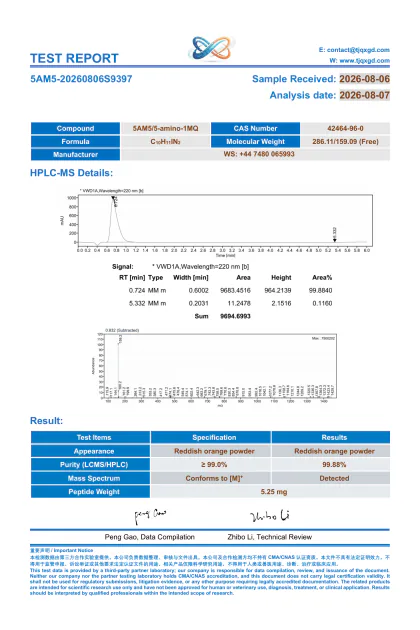
What's on the label is the measured result — net peptide mass, not gross powder weight, plus RP-HPLC purity, on a lot-numbered COA for every batch.
Net peptide mass and RP-HPLC purity — a lot-numbered COA for every batch.
Net peptide mass + HPLC purity, per lot.
PCAC will review 7 peptides for the 503A bulks list, BPC-157, KPV, TB-500, MOTS-c, Emideltide, Semax, Epitalon. Read our briefing →
PCAC will review 7 peptides for the 503A bulks list. Read →
FDA PCAC reviews 7 peptides in July. Read →

NNMT inhibitor (5-Amino-1-methylquinolinium iodide)
PeptideXpo buyer fit
This PeptideXpo page is intentionally positioned for distributors, OEM buyers, and procurement teams comparing 5-Amino-1MQ inside a wider peptide catalog. It is not trying to be the deepest single-molecule monograph; the differentiated intent is assortment planning, export-ready documentation, fill-size comparison, and whether this SKU belongs in a broader buyer program.
Overview
5-Amino-1MQ (5-Amino-1-methylquinolinium iodide) is a small-molecule selective inhibitor of NNMT (nicotinamide N-methyltransferase), the enzyme that catalyzes the methylation of nicotinamide using SAM as methyl donor. By inhibiting NNMT, 5-Amino-1MQ shifts the nicotinamide pool away from the methylated waste-product pathway and toward NAD+ salvage, effectively boosting cellular NAD+ in tissues with high NNMT expression. The molecule has been characterized in adipocyte metabolism, energy-expenditure, and obesity-model research, the working hypothesis being that NNMT inhibition addresses one of the metabolic-pathway aspects of age-related and obesity-related NAD+ decline. PeptideXpo supplies 5-Amino-1MQ as the iodide salt at ≥99.0% HPLC purity. As a small molecule rather than a peptide, the analytical workflow uses RP-HPLC plus UV-Vis identity and GC-MS or LC-MS residual-solvent profiling. Three fill sizes (5, 10, 50 mg) cover most research workflows.
Who buys this, and why
Most buyers in this category are 503A and 503B compounding pharmacies fulfilling metabolic and weight-management protocols, plus research labs investigating GLP-1 / GIP / GCG receptor pharmacology. The procurement decision usually hinges on three things: documented purity at scale, a regulatory team that can respond on destination-market questions in writing, and the ability to supply consistent counter-ion form (acetate by default) across recurring orders.
Primary buyer fit: academic and contract research laboratories.
Specifications
Documentation available on request
Regulatory note
Salt form (iodide vs. other) may vary across suppliers; review the batch COA.
Frequently asked questions
NNMT (Nicotinamide N-methyltransferase) is an enzyme that methylates nicotinamide (the B3 vitamin form) using S-adenosylmethionine (SAM) as methyl donor, producing 1-methylnicotinamide (1-MNA) and S-adenosylhomocysteine (SAH). The reaction consumes both nicotinamide and SAM, two metabolites with separate downstream roles in NAD+ salvage and methylation-cycle balance respectively. NNMT expression is elevated in white adipose tissue of obese subjects, suggesting that NNMT activity is part of the metabolic-dysfunction phenotype. Inhibiting NNMT pharmacologically (with 5-Amino-1MQ) shifts the nicotinamide pool back toward NAD+ salvage and preserves the SAM pool for methylation-cycle reactions, both effects are mechanistically reasonable hypotheses for the observed adipocyte-metabolism research readouts.
5-Amino-1MQ is a quinolinium cation that requires an anion counter-ion for stable solid-state isolation. The iodide salt (5-Amino-1MQ·I⁻) is the most commonly published research-grade form and is what most cited mechanistic studies have used. Alternative counter-ions (bromide, mesylate, sulfate) exist in chemistry catalogs and produce the same cation in solution, but the solid-state behavior, hygroscopicity, and storage stability differ, and some published data is tied specifically to the iodide form. Buyers replicating published protocols should confirm the iodide form on the COA; for novel research, alternative counter-ions are generally acceptable but should be noted in the methods section.
Published mechanistic studies of 5-Amino-1MQ typically use cellular working concentrations in the 1-100 μM range for NNMT inhibition readouts in adipocyte and hepatocyte cell-culture systems. Below 1 μM, the inhibition is sub-saturating and the readouts are noisy; above 100 μM, off-target effects on related methyltransferases begin to confound interpretation. For dose-response curves the typical experimental design uses a 7-point dilution from 0.3 μM to 300 μM with half-log spacing. The molecule's stability in DMSO stock solution is high (months at -20 °C); diluted working solutions in aqueous media should be prepared fresh for each experiment because the quinolinium cation can hydrolyze slowly at neutral pH.
5-Amino-1MQ is mechanistically complementary to direct NAD+ supplementation and to NAD+ precursor supplementation (NMN, NR). Where NAD+ and its precursors add to the nicotinamide pool from the supply side, 5-Amino-1MQ reduces the loss of nicotinamide to NNMT-mediated methylation from the demand side. The combined research strategy of supplementing precursors while inhibiting NNMT is conceptually well-defined, though comparative head-to-head data is still emerging. Buyers building longevity-research protocols often source 5-Amino-1MQ alongside NAD+ and the precursor compounds; PeptideXpo's catalog covers NAD+, 5-Amino-1MQ, and (on request through OEM) NMN and NR.
Related peptides