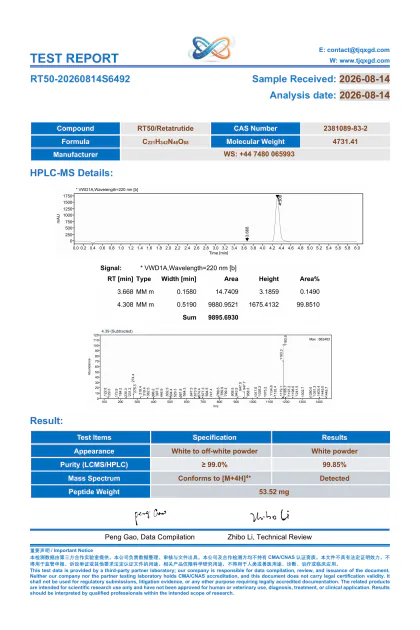
What's on the label is the measured result — net peptide mass, not gross powder weight, plus RP-HPLC purity, on a lot-numbered COA for every batch.
Net peptide mass and RP-HPLC purity — a lot-numbered COA for every batch.
Net peptide mass + HPLC purity, per lot.
PCAC will review 7 peptides for the 503A bulks list, BPC-157, KPV, TB-500, MOTS-c, Emideltide, Semax, Epitalon. Read our briefing →
PCAC will review 7 peptides for the 503A bulks list. Read →
FDA PCAC reviews 7 peptides in July. Read →

GIP / GLP-1 / glucagon tri-agonist
PeptideXpo buyer fit
This page is for sourcing teams deciding how Retatrutide fits into a next-generation metabolic-peptide assortment. It focuses on catalog timing, repeat-order planning, cost curve discussion, and side-by-side comparison with other incretin-pathway SKUs rather than pharmacy release-file ownership.
Overview
Retatrutide (Eli Lilly development code LY3437943) is a 39-amino-acid investigational tri-agonist peptide targeting the GIP, GLP-1, and glucagon receptors. The glucagon-receptor component differentiates Retatrutide from the dual-agonist class (Tirzepatide, Mazdutide, Survodutide) by adding direct hepatic-energy-expenditure modulation on top of the incretin-driven glycemic and weight effects, which is the mechanistic basis for the larger weight-reduction signals observed in Phase 2 trials versus prior best-in-class agents. PeptideXpo supplies lyophilized Retatrutide acetate at ≥99.0% HPLC with batch-specific analytical packet: peak-integration HPLC, ESI mass spec for identity, water content, and counter-ion. Bacterial endotoxin (LAL, USP <85>) and microbial limits (USP <61>/<62>) are available as add-on testing for in vivo workflows and 503A / 503B compounding pharmacy use. Eight standard fill sizes (5 mg through 60 mg) cover both research aliquot scales and dispensing-vial workflows. Bulk pricing tightens significantly at the 100 g and 1 kg break points, Retatrutide aggregate production volumes are lower than for Semaglutide / Tirzepatide, so the per-mg cost curve is steeper but stabilizes once a recurring synthesis route is locked.
Who buys this, and why
Most buyers in this category are 503A and 503B compounding pharmacies fulfilling metabolic and weight-management protocols, plus research labs investigating GLP-1 / GIP / GCG receptor pharmacology. The procurement decision usually hinges on three things: documented purity at scale, a regulatory team that can respond on destination-market questions in writing, and the ability to supply consistent counter-ion form (acetate by default) across recurring orders.
Primary buyer fit: 503A / 503B compounding pharmacies and academic and contract research laboratories.
Specifications
Documentation available on request
Regulatory note
Investigational compound currently in clinical development; not approved as a finished drug in any jurisdiction. Sold as a bulk active for research and, in markets where regulations permit, for compounding-pharmacy use under the receiving pharmacy's quality system. Buyers are responsible for verifying compounding eligibility against the destination market's current regulatory posture.
Frequently asked questions
Tirzepatide is a dual GIP / GLP-1 agonist; Retatrutide adds glucagon-receptor agonism for tri-mechanism activity. The glucagon arm contributes hepatic-energy-expenditure effects that are absent from the dual-agonist class, the practical readout in Phase 2 has been larger weight-reduction magnitudes than any prior peptide in the metabolic space, including Tirzepatide at comparable exposure ranges. Sequence-wise both are 39-amino-acid peptides with C20 fatty-diacid lipidation, but the receptor-binding determinants and the fatty-acid linker geometry differ.
Retatrutide is still investigational, so commercial-pharmacy compounding in most jurisdictions is constrained to the same shortage / regulatory considerations that apply to other unapproved actives. Most current Retatrutide volume goes to: (1) pre-clinical and translational research labs studying tri-agonist receptor pharmacology, (2) compounding pharmacies in markets with permissive frameworks for investigational-stage actives, and (3) regulated buyers building IND-track or analogous documentation packages. All three need batch-specific COA depth, and PeptideXpo can supply the underlying chromatograms and mass-spec raw data files as COA attachments for documentation-track buyers.
Aggregate production volume drives unit cost on synthetic peptides in this class, and Retatrutide volumes are still a small fraction of Tirzepatide / Semaglutide. The synthesis itself is more demanding (longer SPPS sequence with tighter purification cycles to clear closely-eluting deletion sequences). Pricing improves materially at the 100 g and 1 kg break points and tightens further on repeat orders against a locked synthesis route, first-quote economics are not representative of recurring-order economics.
Related peptides