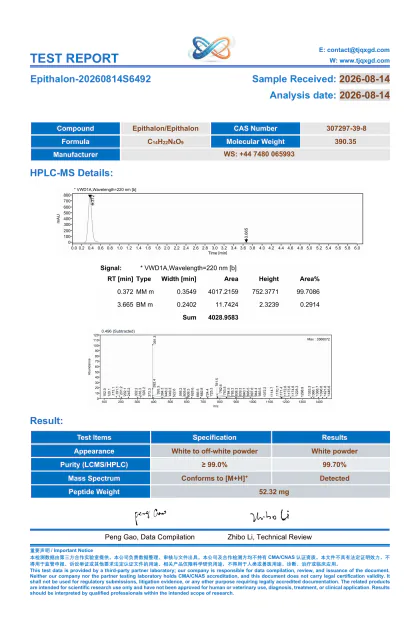
What's on the label is the measured result — net peptide mass, not gross powder weight, plus RP-HPLC purity, on a lot-numbered COA for every batch.
Net peptide mass and RP-HPLC purity — a lot-numbered COA for every batch.
Net peptide mass + HPLC purity, per lot.
PCAC will review 7 peptides for the 503A bulks list, BPC-157, KPV, TB-500, MOTS-c, Emideltide, Semax, Epitalon. Read our briefing →
PCAC will review 7 peptides for the 503A bulks list. Read →
FDA PCAC reviews 7 peptides in July. Read →

Pineal gland tetrapeptide
PeptideXpo buyer fit
This PeptideXpo page is intentionally positioned for distributors, OEM buyers, and procurement teams comparing Epitalon inside a wider peptide catalog. It is not trying to be the deepest single-molecule monograph; the differentiated intent is assortment planning, export-ready documentation, fill-size comparison, and whether this SKU belongs in a broader buyer program.
Overview
Epitalon (also written Epithalon) is a synthetic tetrapeptide (Ala-Glu-Asp-Gly) developed by Vladimir Khavinson and the St. Petersburg Institute of Bioregulation and Gerontology as a synthetic analog of a tetrapeptide fraction isolated from bovine pineal gland (Epithalamin). The molecule has been studied since the 1980s for effects on telomerase activity, telomere length maintenance, circadian-rhythm regulation through pineal-melatonin signaling, and broader longevity readouts, making it the canonical Khavinson-class short-peptide bioregulator and the most clinically studied member of the family. PeptideXpo supplies Epitalon acetate as a lyophilized powder at ≥99.0% HPLC purity. The four-residue sequence is straightforward in SPPS and the analytical packet covers peak-integration HPLC plus mass spec, sequence verification is rarely the critical test for a tetrapeptide. Standard 10 mg and 50 mg fill sizes cover both research aliquot scales and compounding-pharmacy dispensing workflows. Epitalon's broad use in cyclic dosing protocols means buyers typically purchase larger fills than for most short peptides; the 50 mg vial is the more common size for sustained-research and compounding contexts.
Who buys this, and why
Buyers for longevity-class peptides span research labs working on telomere, collagen, and circadian-rhythm models, plus cosmetic-formulation OEMs incorporating peptides like GHK-Cu into anti-aging finished products. Copper peptides in particular require attention to chelator-free water and EDTA-free buffers in downstream formulation work, incompatibility there is the most common cause of "the peptide didn't work" support tickets in this class.
Primary buyer fit: 503A / 503B compounding pharmacies and academic and contract research laboratories.
Specifications
Documentation available on request
Regulatory note
Currently under FDA PCAC review (July 2026) for inclusion on the 503A bulks list with the proposed indication of insomnia. Sold for research and commercial use in compliance with the buyer's local regulations.
Frequently asked questions
Epitalon is the most-studied member of the Khavinson-class short-peptide bioregulators, a research lineage developed at the St. Petersburg Institute of Bioregulation and Gerontology that includes Cortagen (AEDP), Bronchogen (AEDL), Pinealon (EDR), Vesugen (KED), and several others. The shared design pattern is short (typically 3-4 amino acids) sequences derived from tissue-specific peptide fractions isolated from animal tissues, hypothesized to act as endogenous bioregulators of cell-cycle and gene-expression programs in their respective target tissues. Epitalon is the prototype and the most rigorously studied; the others have varying levels of supporting evidence.
Epitalon is on the July 2026 FDA Pharmacy Compounding Advisory Committee agenda with the proposed indication of insomnia, reflecting the molecule's most consistently reported clinical effect across the Russian research literature: melatonin-pathway modulation and improved sleep architecture in older subjects. If the FDA accepts PCAC's recommendation to add Epitalon to the 503A bulks list, US compounding pharmacies could formulate patient-specific Epitalon preparations under 503A. Until the FDA acts, US compounding use is constrained by the current regulatory posture.