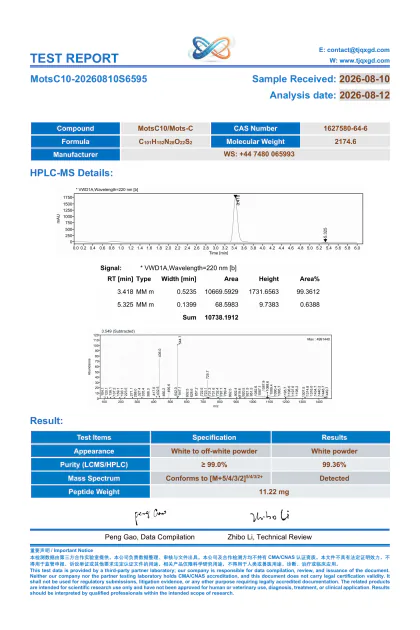
What's on the label is the measured result — net peptide mass, not gross powder weight, plus RP-HPLC purity, on a lot-numbered COA for every batch.
Net peptide mass and RP-HPLC purity — a lot-numbered COA for every batch.
Net peptide mass + HPLC purity, per lot.
PCAC will review 7 peptides for the 503A bulks list, BPC-157, KPV, TB-500, MOTS-c, Emideltide, Semax, Epitalon. Read our briefing →
PCAC will review 7 peptides for the 503A bulks list. Read →
FDA PCAC reviews 7 peptides in July. Read →

Mitochondrial-derived peptide
PeptideXpo buyer fit
This PeptideXpo page is intentionally positioned for distributors, OEM buyers, and procurement teams comparing MOTS-c inside a wider peptide catalog. It is not trying to be the deepest single-molecule monograph; the differentiated intent is assortment planning, export-ready documentation, fill-size comparison, and whether this SKU belongs in a broader buyer program.
Overview
MOTS-c is a 16-amino-acid mitochondrial-derived peptide (sequence MRWQEMGYIFYPRKLR) encoded within the 12S ribosomal RNA region of the human mitochondrial genome. It is one of the better-characterized members of the emerging field of mitochondrial-derived peptides (MDPs), which represent a novel class of small peptides translated from short open reading frames within mitochondrial rRNAs. MOTS-c signals through AMPK-pathway activation and has been studied for effects on insulin sensitivity, exercise capacity, glucose metabolism, weight regulation, and age-related mitochondrial dysfunction, making it one of the most translationally promising peptides in the mitochondrial-research category. PeptideXpo supplies MOTS-c acetate as a lyophilized powder at ≥99.0% HPLC purity. The analytical packet covers peak-integration HPLC, mass spec confirming the ~2174.6 Da theoretical mass, water content, and counter-ion. Sequence verification by LC-MS/MS is available on request. The molecule's relatively short half-life in plasma (minutes to low hours) makes it a research tool for acute mitochondrial-signaling studies rather than chronic-elevation work, protocols typically use repeated dosing or sustained-release formulations to maintain biological exposure. Four standard fill sizes (10-40 mg) accommodate both research aliquot work and compounding-pharmacy dispensing.
Who buys this, and why
Mitochondrial-targeted peptides ship primarily to research labs studying OXPHOS, ROS biology, and mitochondrial dysfunction in disease models. The lipophilic / cationic character that drives mitochondrial accumulation also makes these peptides somewhat oxidation-prone in solution, working stocks should be prepared fresh or held at -80 °C rather than -20 °C when the workflow permits.
Primary buyer fit: 503A / 503B compounding pharmacies and academic and contract research laboratories.
Specifications
Documentation available on request
Regulatory note
Currently under FDA PCAC review (July 2026) for inclusion on the 503A bulks list with the proposed indications of obesity and osteoporosis.
Frequently asked questions
MOTS-c was one of the first mitochondrial-derived peptides (MDPs) identified, a class of small peptides translated from short open reading frames within mitochondrial ribosomal RNA. The discovery upended the conventional view that mitochondrial DNA encodes only 13 protein products (subunits of the OXPHOS complexes), revealing a second tier of nucleus-targeted signaling peptides emerging from mitochondrial transcripts. MOTS-c specifically acts retrograde from mitochondria to nucleus, activating AMPK-pathway signaling and modulating nuclear gene expression in response to metabolic stress. The mechanism is mechanistically distinct from most other peptide therapeutics in the longevity / metabolism space.
Both are research peptides relevant to mitochondrial biology, but they act through completely different mechanisms. MOTS-c is an endogenously-encoded peptide that signals retrograde from mitochondria to nucleus through AMPK and related metabolic-sensor pathways, its activity is essentially signaling and gene-expression modulation. SS-31 (Elamipretide) is a synthetic mitochondria-targeted peptide that accumulates in the inner mitochondrial membrane and protects cardiolipin from peroxidation, its activity is direct biochemical protection of OXPHOS machinery. Buyers selecting between them should match the mechanism to the experimental question: metabolic signaling research favors MOTS-c; oxidative-stress and OXPHOS-integrity research favors SS-31.