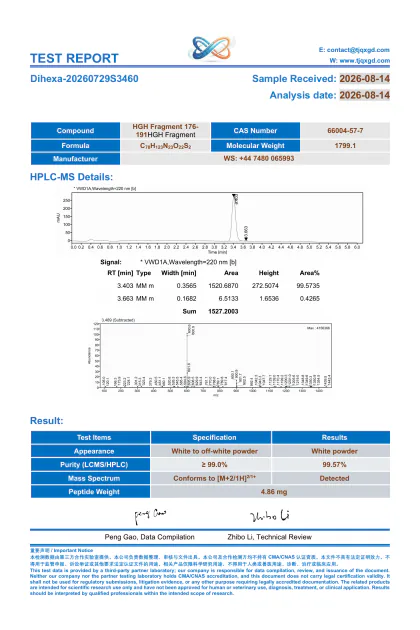
What's on the label is the measured result — net peptide mass, not gross powder weight, plus RP-HPLC purity, on a lot-numbered COA for every batch.
Net peptide mass and RP-HPLC purity — a lot-numbered COA for every batch.
Net peptide mass + HPLC purity, per lot.
PCAC will review 7 peptides for the 503A bulks list, BPC-157, KPV, TB-500, MOTS-c, Emideltide, Semax, Epitalon. Read our briefing →
PCAC will review 7 peptides for the 503A bulks list. Read →
FDA PCAC reviews 7 peptides in July. Read →

C-terminal fragment of human growth hormone (176–191)
PeptideXpo buyer fit
This PeptideXpo page is intentionally positioned for distributors, OEM buyers, and procurement teams comparing HGH Fragment 176-191 inside a wider peptide catalog. It is not trying to be the deepest single-molecule monograph; the differentiated intent is assortment planning, export-ready documentation, fill-size comparison, and whether this SKU belongs in a broader buyer program.
Overview
HGH Fragment 176-191 is the unmodified 16-amino-acid C-terminal fragment of native human growth hormone, corresponding to residues 176-191 of the full-length 191-amino-acid HGH protein. The fragment retains the lipolytic activity associated with this region of native HGH while lacking the central regions that mediate the broader anabolic and IGF-1-stimulating effects of full-length GH. Distinct from the AOD9604 modified analog (which adds an N-terminal tyrosine for iodination-tracking purposes), HGH Fragment 176-191 is the unmodified native sequence and is the form typically used in research workflows studying the lipolytic activity of the HGH C-terminal region in isolation from the rest of the molecule. PeptideXpo supplies HGH Fragment 176-191 at ≥99.0% HPLC purity with full identification: CAS 66004-57-7, formula C78H123N23O22S2, MW 1799.1 g/mol, sequence FLRIVQCRSVEGSCGF (note the two cysteines at positions 7 and 14 that can form an intramolecular disulfide bridge under oxidative conditions). The disulfide-bridging behavior is the most common identity-confirmation concern, the reduced and oxidized forms differ by 2 Da and elute at different RP-HPLC retention times. Six standard fill sizes (1-15 mg) cover most research and compounding workflows.
Who buys this, and why
GH-axis peptides ship to two main buyer types: compounding pharmacies dispensing under physician supervision, and research labs studying somatotropic-axis pharmacology. Pharmacies typically want sterile-filled vials with the full release packet (sterility, endotoxin, CCI); labs typically want bulk lyophilized powder with sequence verification. Blends (the CJC-1295 / Ipamorelin combination is the canonical example) are usually co-lyophilized rather than solution-mixed for potency stability.
Primary buyer fit: academic and contract research laboratories and 503A / 503B compounding pharmacies.
Specifications
Documentation available on request
Regulatory note
Easily confused with AOD9604 (the modified analog with N-terminal tyrosine). Confirm exact fragment identity (unmodified vs. AOD9604-modified) via batch COA before order placement; the two are not chemically equivalent.
Frequently asked questions
The two molecules differ at the N-terminal residue: AOD9604 is Tyr-hGH(177-191) — an N-terminal tyrosine on residues 177-191, a 16-amino-acid molecule with theoretical MW ≈1815 Da — while HGH Fragment 176-191 is the unmodified native 16-amino-acid sequence (phenylalanine at position 176) at theoretical MW ≈1799 Da. The ≈16 Da mass difference (Phe→Tyr adds one oxygen) is the diagnostic mass-spec check at first-time supplier qualification. The two forms also resolve at slightly different RP-HPLC retention times under typical conditions. Buyers should always confirm the released-batch mass against the expected mass for the form they ordered, since the molecules are easy to confuse but biologically distinct.
The 176-191 sequence (FLRIVQCRSVEGSCGF) contains two cysteines (positions 7 and 14 within the fragment) that can form an intramolecular disulfide bond. Under reducing conditions during synthesis, the cysteines are free thiols; under oxidative conditions during storage and reconstitution, they can form the disulfide bridge. The reduced and oxidized forms differ by 2 Da in mass and elute at different RP-HPLC retention times. Most published research uses the oxidized (disulfide-bridged) form, which is the more stable solid-state form. Buyers should confirm with the COA which form the batch represents, if your research protocol requires a specific form, this matters operationally.
Related peptides