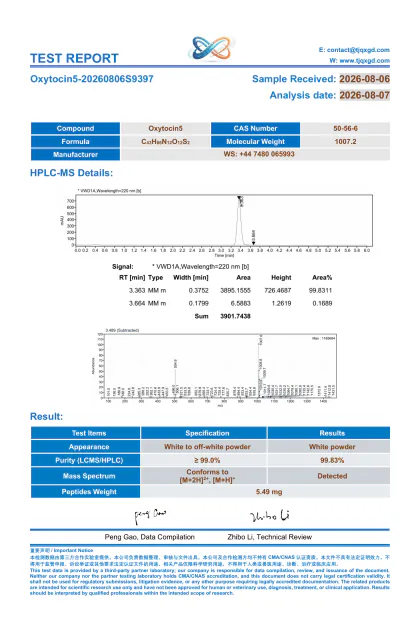
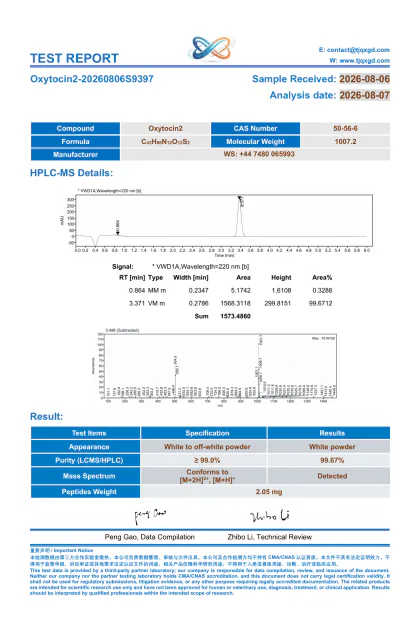
What's on the label is the measured result — net peptide mass, not gross powder weight, plus RP-HPLC purity, on a lot-numbered COA for every batch.
Net peptide mass and RP-HPLC purity — a lot-numbered COA for every batch.
Net peptide mass + HPLC purity, per lot.
PCAC will review 7 peptides for the 503A bulks list, BPC-157, KPV, TB-500, MOTS-c, Emideltide, Semax, Epitalon. Read our briefing →
PCAC will review 7 peptides for the 503A bulks list. Read →
FDA PCAC reviews 7 peptides in July. Read →

Posterior-pituitary neuropeptide hormone · regulated
PeptideXpo buyer fit
This PeptideXpo page is intentionally positioned for distributors, OEM buyers, and procurement teams comparing Oxytocin inside a wider peptide catalog. It is not trying to be the deepest single-molecule monograph; the differentiated intent is assortment planning, export-ready documentation, fill-size comparison, and whether this SKU belongs in a broader buyer program.
Overview
Oxytocin is a nonapeptide hormone (Cys-Tyr-Ile-Gln-Asn-Cys-Pro-Leu-Gly-NH₂) synthesized in the magnocellular neurons of the hypothalamic paraventricular and supraoptic nuclei and released from the posterior pituitary into systemic circulation. The molecule's defining structural feature is the disulfide bridge between Cys1 and Cys6, creating a cyclic 6-residue core with a 3-residue C-terminal tail, this cyclic structure is essential for receptor binding and is the diagnostic identity check on a properly synthesized oxytocin batch. Oxytocin is approved as a prescription drug in essentially all major jurisdictions for obstetric indications (labor induction, postpartum hemorrhage control) and is studied across social-behavior, stress-response, pair-bonding, and smooth-muscle research contexts. PeptideXpo supplies Oxytocin as a lyophilized powder at ≥99.0% HPLC purity. The disulfide-cyclized structure requires careful oxidative folding during synthesis, the linear precursor must be cyclized under controlled conditions to favor the correct intramolecular disulfide over scrambled intermolecular by-products. The analytical packet covers peak-integration HPLC, mass spec confirming the cyclized mass (1007.19 g/mol average, 2 Da lower than the reduced linear form due to the disulfide formation), water content, and counter-ion. Oxytocin's regulated status worldwide means buyers must demonstrate appropriate licensing for their jurisdiction; the documentation packet supports both compounding pharmacy and research workflows.
Specifications
Documentation available on request
Regulatory note
Highly regulated hormone approved as a prescription drug in essentially all major jurisdictions (brand names Pitocin, Syntocinon, and generic equivalents). Sold only to qualified buyers with appropriate licensing in their jurisdiction. Order requires compliance review and may require import authorization documentation for the destination market.
Frequently asked questions
Oxytocin's biological activity depends entirely on the cyclic structure formed by the Cys1-Cys6 disulfide bond, the linear (reduced) form has essentially no receptor binding activity. The disulfide formation during synthesis is a controlled oxidative-folding step that must favor the intramolecular cyclization over intermolecular disulfide formation between molecules. The analytical confirmation is a mass-spec check at the cyclized mass (2 Da lower than the linear reduced form) plus an HPLC retention-time check against a reference standard, since the cyclic and linear forms elute at different positions. Buyers should request the COA to confirm both checks were performed and the cyclized form is the dominant species.
Bulk oxytocin sources support two main research workflows: (1) social-behavior and pair-bonding research in rodent models (intranasal or central administration), where the bulk active is needed for preparation of dosing solutions outside the volume-constraint of finished-drug ampoules, and (2) smooth-muscle and reproductive-tissue research in isolated organ-bath or cell-culture contexts. For both workflows, the analytical packet emphasis is on confirming the cyclized active form and endotoxin testing (LAL) on the specific batch for in vivo work. Buyers with compounding pharmacy use cases should reference local regulator-approved finished products rather than bulk active where the finished drug is available.
Related peptides