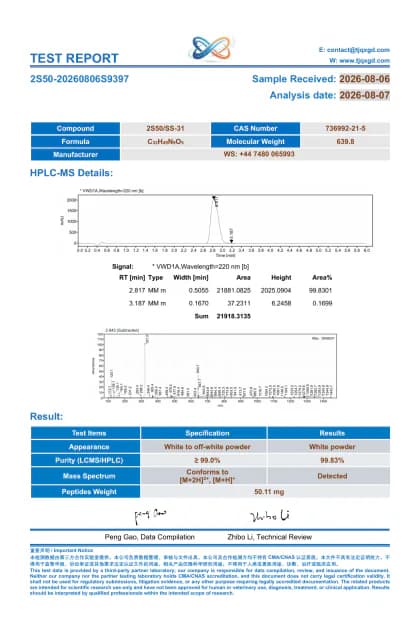
What's on the label is the measured result — net peptide mass, not gross powder weight, plus RP-HPLC purity, on a lot-numbered COA for every batch.
Net peptide mass and RP-HPLC purity — a lot-numbered COA for every batch.
Net peptide mass + HPLC purity, per lot.
PCAC will review 7 peptides for the 503A bulks list, BPC-157, KPV, TB-500, MOTS-c, Emideltide, Semax, Epitalon. Read our briefing →
PCAC will review 7 peptides for the 503A bulks list. Read →
FDA PCAC reviews 7 peptides in July. Read →

Mitochondrial-targeted peptide
PeptideXpo buyer fit
This PeptideXpo page is intentionally positioned for distributors, OEM buyers, and procurement teams comparing SS-31 (Elamipretide) inside a wider peptide catalog. It is not trying to be the deepest single-molecule monograph; the differentiated intent is assortment planning, export-ready documentation, fill-size comparison, and whether this SKU belongs in a broader buyer program.
Overview
SS-31 (also known as Elamipretide, Bendavia, MTP-131) is a synthetic cationic-aromatic tetrapeptide (D-Arg-Dmt-Lys-Phe-NH₂, where Dmt is 2',6'-dimethyl-L-tyrosine) engineered as a Szeto-Schiller (SS) peptide, a class of cell-permeable mitochondria-targeted peptides developed by Hazel Szeto. The cationic-aromatic pattern allows passive accumulation in the inner mitochondrial membrane driven by the negative membrane potential, where SS-31 binds cardiolipin and protects the lipid from peroxidative damage. The protection of cardiolipin in turn preserves the structural integrity of the cristae and the function of the OXPHOS supercomplexes, the mechanistic basis for SS-31's clinical-development program in mitochondrial dysfunction disorders (Barth syndrome, primary mitochondrial myopathies) and acute-injury contexts (ischemia-reperfusion injury, contrast-induced nephropathy). PeptideXpo supplies SS-31 acetate as a lyophilized powder at ≥99.0% HPLC purity. The Dmt (2',6'-dimethyltyrosine) residue is non-natural and requires specialized Fmoc-protected building blocks, the analytical packet includes mass spec confirming the modified mass and is the diagnostic identity check at +28 Da relative to the natural-Tyr analog. Sequence verification by LC-MS/MS is recommended at first-time supplier qualification because Dmt-substituted peptides can have similar retention to unmodified analogs that are biologically inactive. Three fill sizes (5, 10, 50 mg) cover most research and compounding workflows.
Who buys this, and why
Mitochondrial-targeted peptides ship primarily to research labs studying OXPHOS, ROS biology, and mitochondrial dysfunction in disease models. The lipophilic / cationic character that drives mitochondrial accumulation also makes these peptides somewhat oxidation-prone in solution, working stocks should be prepared fresh or held at -80 °C rather than -20 °C when the workflow permits.
Primary buyer fit: academic and contract research laboratories and 503A / 503B compounding pharmacies.
Specifications
Documentation available on request
Regulatory note
Sold for research use only. Not approved as a drug product in any jurisdiction at the time of shipment. Buyers running in vivo studies should request bacterial endotoxin and microbial-limit testing on the specific batch as part of the analytical packet.
Frequently asked questions
The Dmt (2',6'-dimethyl-L-tyrosine) at position 2 is critical to SS-31's biological activity for two reasons. First, the additional methyl groups increase the aromatic π-electron density and the hydrophobic surface area, both of which contribute to the cationic-aromatic motif that drives mitochondrial accumulation and cardiolipin binding. Second, Dmt is resistant to the aminopeptidase cleavage that would degrade the natural-Tyr analog, giving SS-31 a longer functional half-life in plasma and intracellular compartments. The natural-Tyr analog is a useful negative control in research but is not biologically equivalent.
SS-31's selectivity for mitochondrial accumulation comes from the combination of its overall +3 net cationic charge at physiological pH plus the aromatic / hydrophobic groups (Dmt and Phe). The inner mitochondrial membrane has a strongly negative trans-membrane potential (-180 mV in healthy cells), which drives the accumulation of cationic-aromatic molecules by 100- to 1000-fold over cytoplasmic concentration. SS-31 differs from earlier mitochondria-targeted compounds (like the TPP-conjugates) in that the targeting is built into the peptide backbone itself rather than added as a separate triphenylphosphonium cation, which gives more predictable pharmacokinetics and lower off-target effects on other membrane potentials.
Related peptides