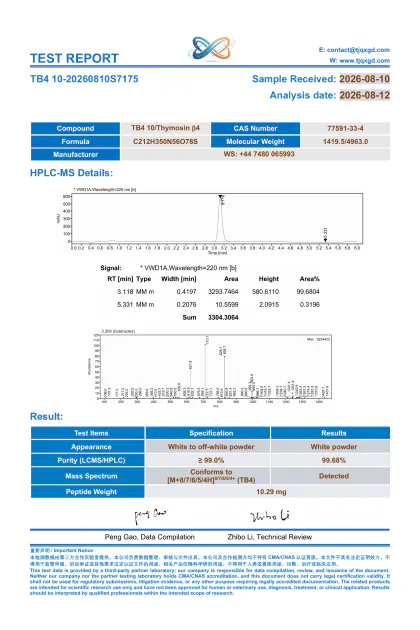
What's on the label is the measured result — net peptide mass, not gross powder weight, plus RP-HPLC purity, on a lot-numbered COA for every batch.
Net peptide mass and RP-HPLC purity — a lot-numbered COA for every batch.
Net peptide mass + HPLC purity, per lot.
PCAC will review 7 peptides for the 503A bulks list, BPC-157, KPV, TB-500, MOTS-c, Emideltide, Semax, Epitalon. Read our briefing →
PCAC will review 7 peptides for the 503A bulks list. Read →
FDA PCAC reviews 7 peptides in July. Read →

Thymosin β4 fragment
PeptideXpo buyer fit
This PeptideXpo page is intentionally positioned for distributors, OEM buyers, and procurement teams comparing TB-500 inside a wider peptide catalog. It is not trying to be the deepest single-molecule monograph; the differentiated intent is assortment planning, export-ready documentation, fill-size comparison, and whether this SKU belongs in a broader buyer program.
Overview
TB-500 is a 43-amino-acid synthetic peptide derived from Thymosin β4 (the actin-sequestering protein expressed natively in nearly every mammalian cell type). The molecule's biological activity centers on actin-binding via its central LKKTETQ motif and downstream effects on cellular migration, angiogenesis, and tissue regeneration, the mechanistic basis for the broad TB-500 research literature on wound healing, cardiac remodeling, and tendon-ligament repair models. TB-500's longer sequence relative to BPC-157 makes it serum-stable but not orally bioavailable, so research workflows are exclusively injectable-route. TB-500 is on the July 2026 FDA PCAC agenda for 503A bulks-list consideration with the proposed indication of wound healing. PeptideXpo supplies TB-500 acetate as a lyophilized powder at ≥99.0% HPLC purity. The 43-residue sequence is at the upper-middle range for routine SPPS, synthesis is reliable but purification cycles are more demanding than for shorter peptides like BPC-157, and the analytical packet emphasizes peak-integration HPLC plus mass spec to clear deletion sequences that elute close to the target peak. Sequence verification by LC-MS/MS is available on request and is the recommended qualification test for any TB-500 supplier, for a 43-mer, mass alone leaves more identity ambiguity than for a 15-mer like BPC-157. TB-500 is most commonly ordered as the standalone vial or as the Wolverine Blend with BPC-157 (5+5 mg per 10 mg vial standard, custom ratios via OEM). For the full BPC-157 vs TB-500 mechanism and analytical comparison, see our [side-by-side article](/insights/bpc-157-vs-tb-500-side-by-side); for the 503A regulatory context, see our [503A vs 503B compounding guide](/insights/503a-vs-503b-compounding-pharmacy-peptides).
Who buys this, and why
Repair peptides, BPC-157, TB-500, and related sequences, typically ship to research labs studying tissue-repair, gastrointestinal, or tendon-ligament models, and to compounding pharmacies that have validated the bulk active into their workflow. The synthesis itself is reliable, but analytical confirmation is where suppliers differ, buyers qualifying a new source should request sequence verification by tandem MS on the first batch and compare against the labelled sequence directly.
Primary buyer fit: 503A / 503B compounding pharmacies and academic and contract research laboratories.
Specifications
Documentation available on request
Regulatory note
Currently under FDA PCAC review (July 2026) for inclusion on the 503A bulks list, with the proposed indication of wound healing.
Frequently asked questions
TB-500 is a 43-amino-acid synthetic peptide derived from a defined region of native Thymosin β4 (which is a 44-residue protein in mammals). The synthetic TB-500 sequence includes the LKKTETQ actin-binding motif that drives the molecule's biological activity. Compared with native Thymosin β4 produced recombinantly, the synthetic TB-500 is more economically accessible at research and commercial scale and avoids the variability that comes with cell-line-expressed material. The biological activity per mass is functionally equivalent for the actin-binding and tissue-regeneration readouts that dominate the TB-500 research literature.
TB-500 is 43 amino acids, which is at the upper-middle end of routine SPPS. Longer peptides accumulate more single-residue deletion sequences during synthesis, and those deletion products elute close to the target peak on RP-HPLC, they pass the standard HPLC purity gate but are not the molecule the buyer ordered. Mass spec alone catches identity to within 0.5 Da but cannot distinguish between, say, a [Lys-deletion at position 12] and a [Lys-deletion at position 30] of equal residue mass. LC-MS/MS sequence verification with full b- and y-ion ladder coverage is the only test that directly demonstrates the synthesized sequence matches the labelled sequence, recommended at first-time supplier qualification for any 40+ residue peptide.
TB-500 and BPC-157 act through different molecular mechanisms, TB-500 is an actin-binding peptide affecting cellular migration and tissue remodeling, while BPC-157 acts through nitric-oxide-pathway modulation and growth-factor-receptor cross-talk. The two are commonly combined in research and compounding contexts because the mechanisms are complementary rather than redundant. The Wolverine Blend SKU bundles both peptides into a single co-lyophilized vial at a standard 5+5 mg ratio (custom ratios available); the combined vial simplifies handling and the analytical packet certifies both components in a single document.