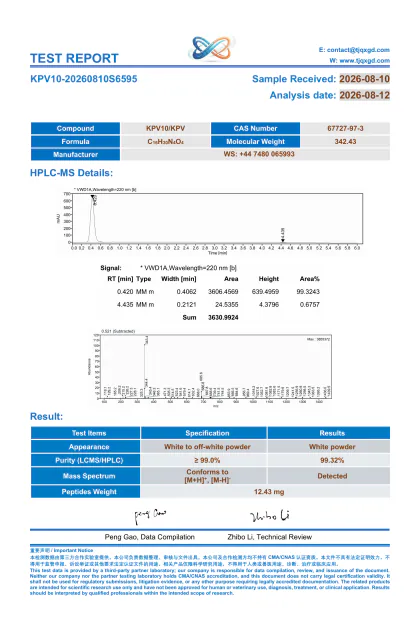
What's on the label is the measured result — net peptide mass, not gross powder weight, plus RP-HPLC purity, on a lot-numbered COA for every batch.
Net peptide mass and RP-HPLC purity — a lot-numbered COA for every batch.
Net peptide mass + HPLC purity, per lot.
PCAC will review 7 peptides for the 503A bulks list, BPC-157, KPV, TB-500, MOTS-c, Emideltide, Semax, Epitalon. Read our briefing →
PCAC will review 7 peptides for the 503A bulks list. Read →
FDA PCAC reviews 7 peptides in July. Read →

Lys-Pro-Val α-MSH C-terminal tripeptide
PeptideXpo buyer fit
This PeptideXpo page is intentionally positioned for distributors, OEM buyers, and procurement teams comparing KPV inside a wider peptide catalog. It is not trying to be the deepest single-molecule monograph; the differentiated intent is assortment planning, export-ready documentation, fill-size comparison, and whether this SKU belongs in a broader buyer program.
Overview
KPV is the C-terminal tripeptide of α-melanocyte-stimulating hormone (α-MSH), consisting of Lys-Pro-Val. The tripeptide retains a substantial portion of the anti-inflammatory activity of the parent α-MSH molecule while losing the pigmentation-related melanocortin-receptor effects, making it the most-studied minimal anti-inflammatory unit of the melanocortin system. KPV is studied in research contexts for inflammatory bowel disease models, dermal wound-healing and inflammation, and as an oral-route anti-inflammatory candidate, its small size and proline content give it unusual oral bioavailability compared with larger inflammation-modulating peptides. PeptideXpo supplies KPV as a lyophilized powder at ≥99.0% HPLC. The short three-residue sequence makes synthesis straightforward and the analytical packet emphasizes peak-integration HPLC plus mass spec. For research workflows studying inflammatory readouts (NF-κB reporters, cytokine panels, macrophage-activation assays), bacterial endotoxin (LAL, USP <85>) testing on the specific batch is strongly recommended because the readout is itself sensitive to endotoxin and ambiguity in the LAL value will confound interpretation. Both standard vial sizes (5 mg and 10 mg) are sufficient for typical research aliquot scales; larger fills are available through OEM for compounding-pharmacy or extended-research workflows.
Who buys this, and why
Buyers in this category are research labs studying immune-modulation, cytokine signaling, and antimicrobial activity. The defining QC requirement is bacterial-endotoxin control: many of the downstream assays (NF-κB reporters, macrophage activation panels, neutrophil-priming readouts) are themselves activated by endotoxin contamination, so a clean LAL on the specific batch is a precondition rather than a nice-to-have. LL-37 and related cationic antimicrobial peptides additionally benefit from low-bind plasticware during dilution.
Primary buyer fit: 503A / 503B compounding pharmacies and academic and contract research laboratories.
Specifications
Documentation available on request
Regulatory note
Currently under FDA PCAC review (July 2026) for inclusion on the 503A bulks list with the proposed indications of wound healing and inflammatory conditions.
Frequently asked questions
Native α-MSH is a 13-amino-acid peptide with two functional regions: an N-terminal melanocortin-receptor-binding sequence that drives pigmentation effects, and a C-terminal Lys-Pro-Val tripeptide that contributes to the anti-inflammatory activity. By isolating just the C-terminal tripeptide, KPV retains a useful fraction of the anti-inflammatory effects while losing the pigmentation-pathway activity that would be a confounding side-effect in most research and therapeutic contexts. The reductionist approach is what makes KPV the preferred tool for studying melanocortin-system anti-inflammatory effects in isolation from melanogenic signaling.
Yes, most peptides are degraded by gastric and intestinal proteases before they can reach systemic circulation, which is why peptide pharmacology is dominated by injectable routes. KPV is a useful exception: its short three-residue sequence (with a Pro in the middle position) gives it enough protease resistance to survive digestion to a meaningful degree, and its small size allows transcellular absorption across intestinal epithelium. This is the mechanistic basis for the published research on oral KPV in inflammatory bowel disease models, the molecule can reach inflamed gut tissue from the lumen side without injection.
For research workflows where the readout is inflammation-related, cytokine release, NF-κB reporters, macrophage activation, neutrophil priming, bacterial endotoxin contamination in the test article will produce false-positive signals because endotoxin itself activates the same pathways being measured. Recommended scope: bacterial endotoxin test (LAL per USP <85>) reported in EU/mg on the specific batch, plus microbial limits (USP <61>/<62>) for in vivo workflows. These are add-on tests on KPV (not standard release scope) and add 3-5 business days of QC turnaround.