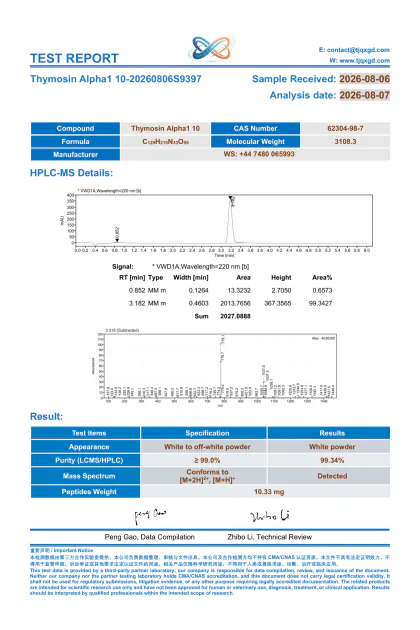
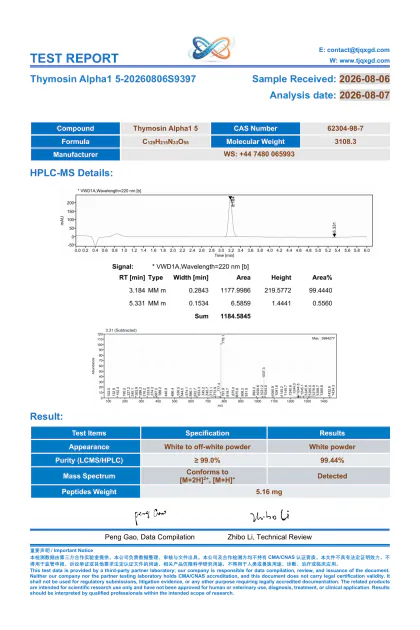
What's on the label is the measured result — net peptide mass, not gross powder weight, plus RP-HPLC purity, on a lot-numbered COA for every batch.
Net peptide mass and RP-HPLC purity — a lot-numbered COA for every batch.
Net peptide mass + HPLC purity, per lot.
PCAC will review 7 peptides for the 503A bulks list, BPC-157, KPV, TB-500, MOTS-c, Emideltide, Semax, Epitalon. Read our briefing →
PCAC will review 7 peptides for the 503A bulks list. Read →
FDA PCAC reviews 7 peptides in July. Read →

28-amino-acid thymic immune-modulation peptide
PeptideXpo buyer fit
This PeptideXpo page is intentionally positioned for distributors, OEM buyers, and procurement teams comparing Thymosin Alpha-1 (Thymalfasin) inside a wider peptide catalog. It is not trying to be the deepest single-molecule monograph; the differentiated intent is assortment planning, export-ready documentation, fill-size comparison, and whether this SKU belongs in a broader buyer program.
Overview
Thymosin Alpha-1 (also known as Thymalfasin, brand name Zadaxin) is a 28-amino-acid N-terminally acetylated peptide originally isolated from bovine thymus and now produced synthetically. It is approved as a prescription biological in over 35 jurisdictions (including China, Italy, India, and several Southeast Asian markets) for indications including chronic hepatitis B, chronic hepatitis C as combination therapy, and as a vaccine adjuvant. The molecule's mechanism centers on enhancement of T-cell maturation and function through TLR-9 dependent dendritic-cell activation, plus broader effects on NK-cell and macrophage activity, the basis for both the antiviral and immune-restoration research interest. PeptideXpo supplies Thymosin Alpha-1 as a lyophilized powder at ≥99.0% HPLC purity. The 28-residue sequence is well within reliable SPPS range, and the N-terminal acetylation is confirmed by mass spec at +42 Da relative to the unmodified peptide. Because Thymosin Alpha-1 is an approved biological in multiple jurisdictions and the supply chain serves both compounding pharmacy and research-lab buyers, the documentation packet emphasizes batch-specific COA depth: HPLC chromatogram, mass spec, water content, counter-ion, and on-request endotoxin (LAL) and microbial limits. Standard 5 mg and 10 mg fills cover most workflows.
Who buys this, and why
Buyers in this category are research labs studying immune-modulation, cytokine signaling, and antimicrobial activity. The defining QC requirement is bacterial-endotoxin control: many of the downstream assays (NF-κB reporters, macrophage activation panels, neutrophil-priming readouts) are themselves activated by endotoxin contamination, so a clean LAL on the specific batch is a precondition rather than a nice-to-have. LL-37 and related cationic antimicrobial peptides additionally benefit from low-bind plasticware during dilution.
Primary buyer fit: 503A / 503B compounding pharmacies and academic and contract research laboratories.
Specifications
Documentation available on request
Regulatory note
Approved as a prescription biological in over 35 jurisdictions including China, Italy, India, and several APAC markets (brand name Zadaxin or generic equivalents). Sold only to qualified buyers with appropriate licensing in their jurisdiction; not approved in the US or EU at the time of writing.
Frequently asked questions
These three are commonly confused but are distinct molecules. Thymosin Alpha-1 (also called Thymalfasin) is a defined 28-amino-acid synthetic peptide with a single CAS (62304-98-7), the molecule with the largest body of clinical data and the approved drug status in multiple jurisdictions. Thymulin is a 9-amino-acid zinc-binding peptide (CAS 63958-90-7), a different molecule with limited approved status. Thymalin is generally not a single defined peptide but a thymic-extract complex with batch-to-batch compositional variation. Buyers should be explicit about which they want at quote stage, they are not interchangeable.
Thymosin Alpha-1 has approved status in over 35 jurisdictions including China, Italy, India, Singapore, the Philippines, and several other markets, primarily for chronic hepatitis B and as a chemotherapy / vaccine adjuvant. The molecule was developed and clinically advanced primarily outside the US, and the FDA-approval pathway was not pursued historically due to commercial considerations rather than safety or efficacy concerns. Buyers in countries where Thymosin Alpha-1 is an approved medication can reference the local registry; buyers elsewhere are supplied on a research-use-only basis.
Lyophilized Thymosin Alpha-1 is stable for the standard 24-month re-test window at -20 °C. The N-terminal acetylation is the diagnostic identity check by mass spec (theoretical MW 3108 Da; the +42 Da relative to the unacetylated form is the confirmation). Sequence verification by LC-MS/MS is recommended at first-time supplier qualification because the 28-residue sequence has multiple Asp and Glu residues whose deamidation byproducts elute close to the target peak on RP-HPLC. For compounding pharmacy use the bacterial endotoxin (LAL) test is the standard add-on; for research workflows the LAL is optional but recommended for any in vivo or immune-cell readout where endotoxin would confound interpretation.
Related peptides