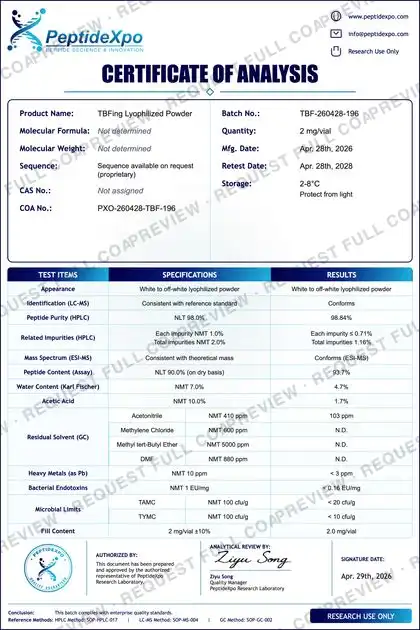
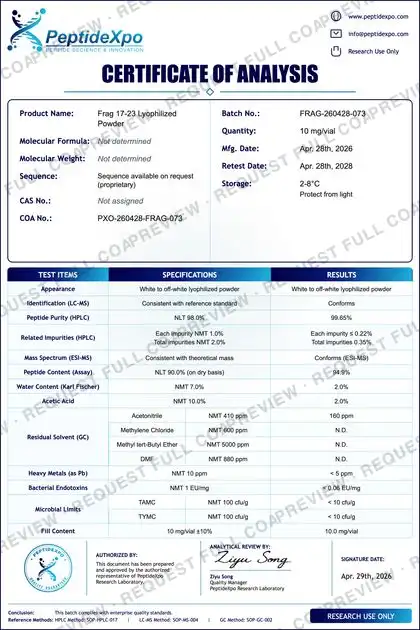
Ask sales for the lot-numbered COA matched to the offered or supplied batch; it records the tests actually completed, their specifications, and the reported results.
Review the matching batch COA for the analytical scope and results recorded for that lot.
Matching batch COA available.
PCAC will review 7 peptides for the 503A bulks list, BPC-157, KPV, TB-500, MOTS-c, Emideltide, Semax, Epithalon. Read our briefing →
PCAC will review 7 peptides for the 503A bulks list. Read →
FDA PCAC reviews 7 peptides in July. Read →

Thymosin β4 active-fragment preparation
Overview
TB-500 Fragment is a shortened fragment preparation of TB-500, the synthetic peptide derived from Thymosin β4 (the actin-sequestering protein expressed natively in nearly every mammalian cell type). Where the full-length TB-500 SKU is the 43-residue peptide with a published sequence, this SKU is the fragment preparation covering the actin-binding region of the same parent protein, ordered by buyers who want the shorter construct for actin-binding, cell-migration, and tissue-remodeling research rather than the full-length molecule. Because "fragment" preparations are not standardized across the market, PeptideXpo does not publish a single canonical CAS, molecular formula, or molecular weight for this SKU: the exact residue span, any terminal modification, and the corresponding mass are listed on batch COA, and that document, not the catalog name, is the identity of record. PeptideXpo supplies TB-500 Fragment as a lyophilized powder at ≥99.0% HPLC purity in 5 mg and 10 mg fills. The release packet covers peak-integration RP-HPLC, ESI mass spec against the identity listed on batch COA, water content, and counter-ion. LC-MS/MS sequence verification is available on request and is the recommended qualification test for any fragment SKU, since a fragment's catalog name alone does not pin the residue span the way a full-length sequence does. Buyers running comparative work against full-length material should order the [TB-500](/products/p/tb-500) SKU alongside this one and derive molar equivalence from each batch COA rather than dosing the two on equal mass. For the mechanism background on the Thymosin β4 family and why sequence-level verification matters for longer repair peptides, see our [BPC-157 vs TB-500 article](/insights/bpc-157-vs-tb-500-side-by-side).
Who buys this, and why
Repair peptides, BPC-157, TB-500, and related sequences, typically ship to research labs studying tissue-repair, gastrointestinal, or tendon-ligament models. Ask sales for the COA matched to the offered or supplied lot. If the buyer's written qualification procedure requires tandem-MS sequence evidence, include it in the agreed scope before quotation rather than treating it as an automatic first-batch retest.
Primary buyer fit: academic and contract research laboratories and regional distributors and re-sellers.
Specifications
Documentation available on request
Regulatory note
Fragment preparation with no single registered CAS; confirm residue span, terminal modification, and mass against the batch COA before use. Not an approved finished drug in any jurisdiction, and buyers should not assume the regulatory posture of full-length TB-500 extends to a fragment preparation. Supplied for research and for commercial use in compliance with the buyer's local regulations.
Frequently asked questions
The full-length TB-500 SKU is the 43-amino-acid synthetic peptide derived from Thymosin β4, and its sequence is published on that product page. TB-500 Fragment is a shorter fragment preparation covering the actin-binding region of the same parent protein. The practical consequence is that the two are different molecules with different masses: they are not interchangeable, and a protocol written for one cannot be transferred to the other on equal mass without re-deriving molar equivalence. Buyers who need the published 43-residue sequence should order the TB-500 SKU; buyers who specifically want the shorter construct should order this one and work from its batch COA.
Because "TB-500 fragment" is a preparation description rather than a standardized chemical identity, and fragment products differ between suppliers in the exact residue span and in whether the termini are modified. Publishing a single CAS, formula, or molecular weight would imply a precision the catalog name does not carry. The identity actually shipped, including the residue span, any terminal modification, and the corresponding theoretical mass, is listed on batch COA for the lot offered. Ask sales for the COA matched to the offered batch before writing the material into a protocol or a specification.
Beyond the standard release scope (peak-integration RP-HPLC, ESI mass spec, water content, counter-ion), LC-MS/MS sequence verification is the test worth adding for any fragment preparation. Mass spec confirms the observed mass matches the identity listed on batch COA, but for a short fragment several plausible residue spans can be close in mass; the b- and y-ion ladder from tandem MS is what directly demonstrates which span was synthesized. This is available when required by the buyer's written analytical scope and is the recommended qualification step the first time a fragment SKU enters a program.
Related peptides
43-mer
Thymosin β4 fragment
15-mer
Body Protection Compound 15-mer
BPC-157 + TB-500 repair-stack blend